Brain Awareness Week 2026: supporting children and young people’s mental health
18/03/2026
Rebecca’s dad had the neurological condition Huntington’s disease. For Brain Awareness Week (16-22 March 2026), Rebecca is sharing her experiences of accessing support services and the positive impact this had on her mental health as a child, as well as the challenges of shifting from children and young people’s to adults’ services.
Rebecca writes:
Huntington’s Disease affects my daily life a lot as there is a constant worry about whether I could have it due to the 50:50 risk (every child conceived naturally to a parent who carries the Huntington’s gene has a 50% chance of inheriting the condition). The Huntington’s Disease Association (HDA)’s support really helps to combat this worry.

How did you first access the support service?
I have been supported by the HDA since I was around 13 years old, when I found out my dad had Huntington’s disease. Youth workers from HDA would reach out to me regularly and were able to answer my questions: they were able to tell me more about the condition, and keep me up to date with developments in research and potential treatments and my options for genetic testing, as well having a chat and asking me how I am. I feel supported, and always knew I could reach out to them anytime I had questions, worries or anxiety.
How is the transition from the young people’s service to the adults’ service going?
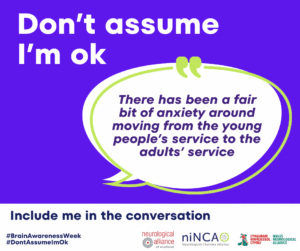
Now I am moving from the young people’s service to the adults’ service. There has been a fair bit of anxiety around this, especially as the adults’ service works differently from the youth service. In the youth service, the youth workers often reach out to the young people, whereas in the adults service it is the person who needs support that contacts the service. I have had some anxiety about this, as it can be hard to reach out and let someone know you need help. It is also quite sad that the time in the youth service is coming to an end, as I have got to know the youth worker I have well, as I have had support from them over a long period of time. This has impacted my mental health as well.
“I feel fortunate. Not everyone with a neurological condition has access to this kind of support”
The transition so far feels like it is going well, I have had a call with the youth worker from the young persons’ service who has discussed the process of moving to the adults’ service with me. We have a transition meeting booked in with the youth worker and the member of staff from the adults’ service for the area I live in, to allow me to get to know the member of staff from the adults’ service while also having the youth worker there. There is an adults’ WhatsApp group through the HDA which I am in, where events that are happening are shared in there and people generally can talk in, which helps to know that there’s support from that too despite it being a different service.
How are your mental health needs being met?
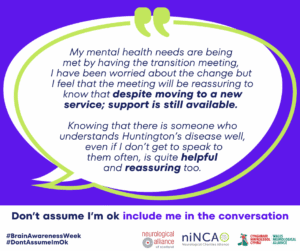
The transition meeting helped meet my mental health needs. I had been worried about the change but the meeting was reassuring to know that despite moving to a new service, support is still available. Knowing that there is someone who understands Huntington’s disease well, even if I don’t get to speak to them often, is quite helpful and reassuring too.
“I always feel I have a choice”
I feel included in decisions about my health. I have considered genetic testing for Huntington’s disease and have been supported really well in making decisions around this. No one has ever made a decision for me regarding this, but they have given me information, resources and time to allow me to make the decision myself. I always feel I have a choice and know I can reach out to the support service anytime I need it.
I feel very happy talking about my journey with the HDA, as it is a charity not everyone knows about so it is an opportunity to educate others. I have also been a part of developing the Huntington’s Disease Youth Voice from 2023-2025 through HDA. The group is made up of 16-28 year olds who work on different projects each year. I’ve had a lot of support from the HDA throughout the time I’ve been involved with them, and I’m still receiving it. Now I am an ambassador for the charity. I feel fortunate, as I know not everyone with a neurological condition has access to this kind of support, especially as a child or young person.
Resources: children and young people’s mental health
Rebecca is sharing her story as part of The Neurological Alliance of Scotland’s #DontAssumeImOK campaign for Brain Awareness Week. Visit their website to read more real life stories and download a toolkit designed to help parents, teachers, health care professionals and others support children and young people’s mental health.